
What Bristol City Deed Records Show
The Circuit Court Clerk for Bristol City records land instruments, maintains the local index, and handles the copy route. A deed can document a conveyance. Other instruments in the deed records show a security interest, a release, an easement, a plat, or a lien. Bristol's official material publishes no complete document-type menu. Read the instrument description in the index, or ask the Clerk to name the record category.
| Deed or instrument | What it does | Common research use |
|---|---|---|
| Deed | Records a transfer or other stated interest in land | Identify grantor, grantee, date, and legal description |
| Deed of trust | Records a security instrument tied to property | Trace a loan instrument and its later release |
| Release or certificate of satisfaction | Records that a prior instrument has been released or satisfied | Check whether an indexed security interest was cleared |
| Easement or right-of-way | Records a defined use or access interest affecting land | Review access and property-use history |
| Plat or map | Shows mapped lots, streets, or subdivision features | Connect a legal description to lot relationships |
| Judgment or lien instrument | Records a claim or court-related interest | Check an encumbrance and its related case or release |
Not every item in this first column is a deed in the narrow sense. Their value is shared. The Clerk's land-record system preserves instruments that can affect title or explain a parcel's recorded history. That is why each one earns its place. A tax account may help you locate the parcel. It never replaces the recorded instrument.
Bristol City Deed Chain
A grantor conveys the interest. The grantee receives it. The deed index is built around parties and instruments, so a search usually starts with an owner name or a parcel reference drawn from a tax or GIS record. The Bristol City Clerk's public pages do not spell out every OCRA search field, the earliest online year, or any result cap. Do not assume the online index reaches every year.
For the newest deed, pull five details: grantee, grantor, recording date, document or book reference, and legal description. Match that description to the parcel itself. A street address alone is not enough. The deed may rely on an older address, a subdivision name, lot and block, or metes-and-bounds language. Deed and plat references form the bridge. They carry you from a modern tax label to the legal land description.
- Find the parcel or owner through the City's tax inquiry or GIS.
- Search the recorded land index for the latest deed that names the owner as grantee.
- Note the parties, instrument type, date, book/page or document reference, and legal description.
- Compare the parcel description with the current map and any cited plat.
- Ask the Clerk to inspect or provide the recorded image if the online index is not enough.
- Grantor
- The party who conveys the stated interest.
- Grantee
- The party to whom the stated interest is conveyed.
- Chain of title
- The linked sequence of recorded instruments that traces conveyances over time.
- Legal description
- The written land description, which can be more useful than a street address for older records.
- Recorded copy
- An image or copy from the Clerk's record. It documents what was filed, not every possible claim.
Bristol OCRA Deed Images
Bristol routes remote deed images through OCRA. OCRA is the City of Bristol Circuit Court Case Imaging System. A subscription is required. The Clerk's office handles the setup. The public page leaves several questions open. These include the subscription price, the full set of search fields, and the years of deed records available online. Anyone relying on OCRA should treat it as a remote imaging route. The Clerk must confirm its terms. It is not an open image library with a stated coverage range.
Visiting in person remains an option. The Clerk's office sits at 497 Cumberland Street, Room 210. Hours are Monday through Friday from 8:00 a.m. to 4:30 p.m., with land recordings accepted until 4:00 p.m. For a specific instrument or copy request, call 276-645-7321 ahead of the trip. The courthouse route matters most when an online search result cannot be read. It also matters when a certified copy is needed.
Bristol's official OCRA page posts the subscription route and application. That makes it the clearest local source for remote image access. Still, the Clerk should confirm current subscriber steps and charges. The OCRA page also spells out the subscription requirement itself. That distinction matters when an index match is visible but the underlying deed image is not.
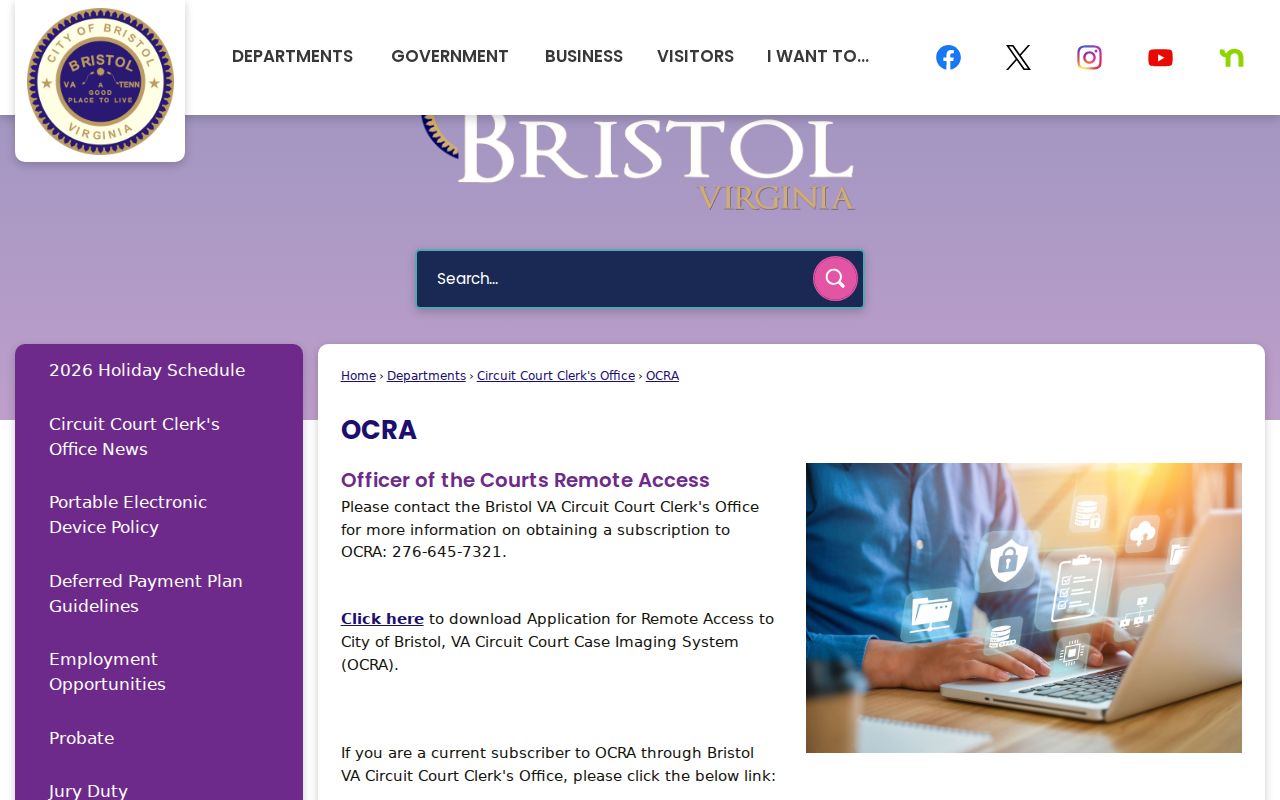
When the image will not load, carry the index reference to the Clerk's counter. Request inspection or a copy there.
SRA Index for Bristol Deeds
Virginia's Secure Remote Access system explains that circuit-clerk land records may be reached through SRA/COVERS. A clerk may enable free index-only access. Images stay restricted to subscribers authorized by that clerk. Users sign an agreement and may pay applicable fees. The statewide explanation is general. It does not promise that every Bristol instrument or image appears the same way.
The SRA landing page warns that online records may be incomplete, outdated, or inaccurate. They are not the official record. Use an index entry as a locator. Verify against the recorded image or ask the Clerk to confirm. A failed search is common. Vary the party spelling. Use the known date range or reference when speaking with the office.
The Virginia Judicial System SRA overview sets out the line between a free index and restricted images. Bristol's own route remains the local Clerk's OCRA page and courthouse counter. The statewide land-record entry is a search gateway. It is not a promise of free images for Bristol.
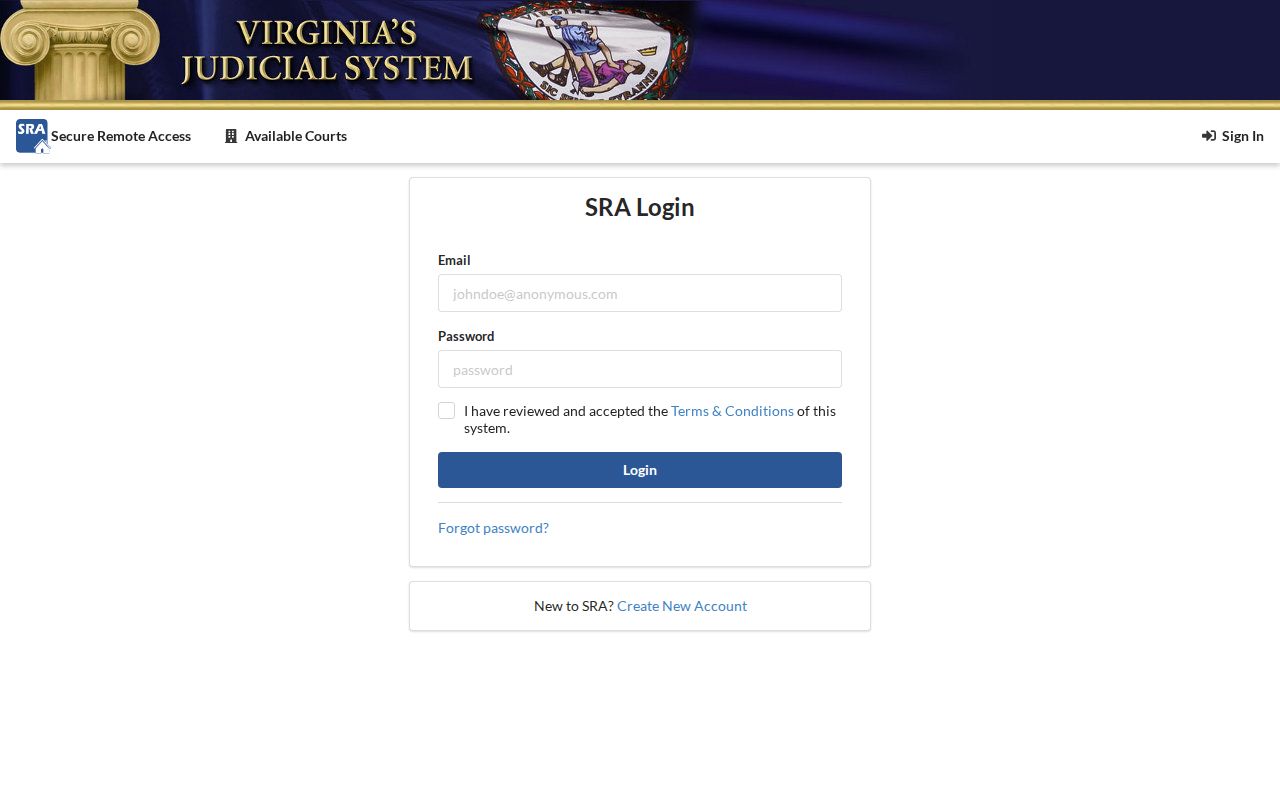
When the index alone leaves a question, title confirmation requires the actual recorded instrument. Request it from the local custodian.
Bristol's Historic Deed Index Years
The Library of Virginia's Bristol City microfilm catalog offers a clear historical route. The modern OCRA pages state no online cutoff. Deed books start at 1890 in the early volumes. General deed indexes cover three blocks of years. That index material is a finding aid to older records, not proof that a present-day online query reaches back to 1890.
- General deed index, 1890–1911, listed with the early index reel.
- General deed index, 1911–1933, also listed in the catalog.
- Further general deed index, 1942–1956, listed on a later reel.
- Deed books from 1890–1891 and continuation volumes into 1901 appear in the collection inventory.
Beyond deeds, the catalog points to wills, marriage registers, and city council minute books. Minutes matter. They can record street openings, public acquisitions, and other development decisions. A minute book never replaces a recorded deed, though. Some reels are flagged for interlibrary loan, so a local library can arrange access. If a period you need is not listed, ask the Clerk or the Library of Virginia. Do not assume the records do not exist.
Virginia Recording Fees for Bristol Deeds
Virginia Code section 17.1-275 fixes the recording and indexing charges by instrument length. The brackets are simple. A document of ten pages or fewer costs $18. Eleven through thirty pages costs $32. Thirty-one or more pages costs $52. Oversize plats and maps run $17 per page or sheet. The statute adds a permanent-record preservation component along with other clerk service charges. These are statutory recording charges only. They are not necessarily Bristol's price for a copy or an OCRA subscription. The Clerk publishes no current local image-copy fee or subscription price on an official page. Ask the Clerk for a copy estimate before ordering a large set. Keep a certified copy distinct from remote viewing or a new instrument filing. The official Virginia fee schedule lays out the page-count brackets. The statutory schedule shown below offers a quick visual reference. The Clerk can confirm which charge applies to a particular filing.
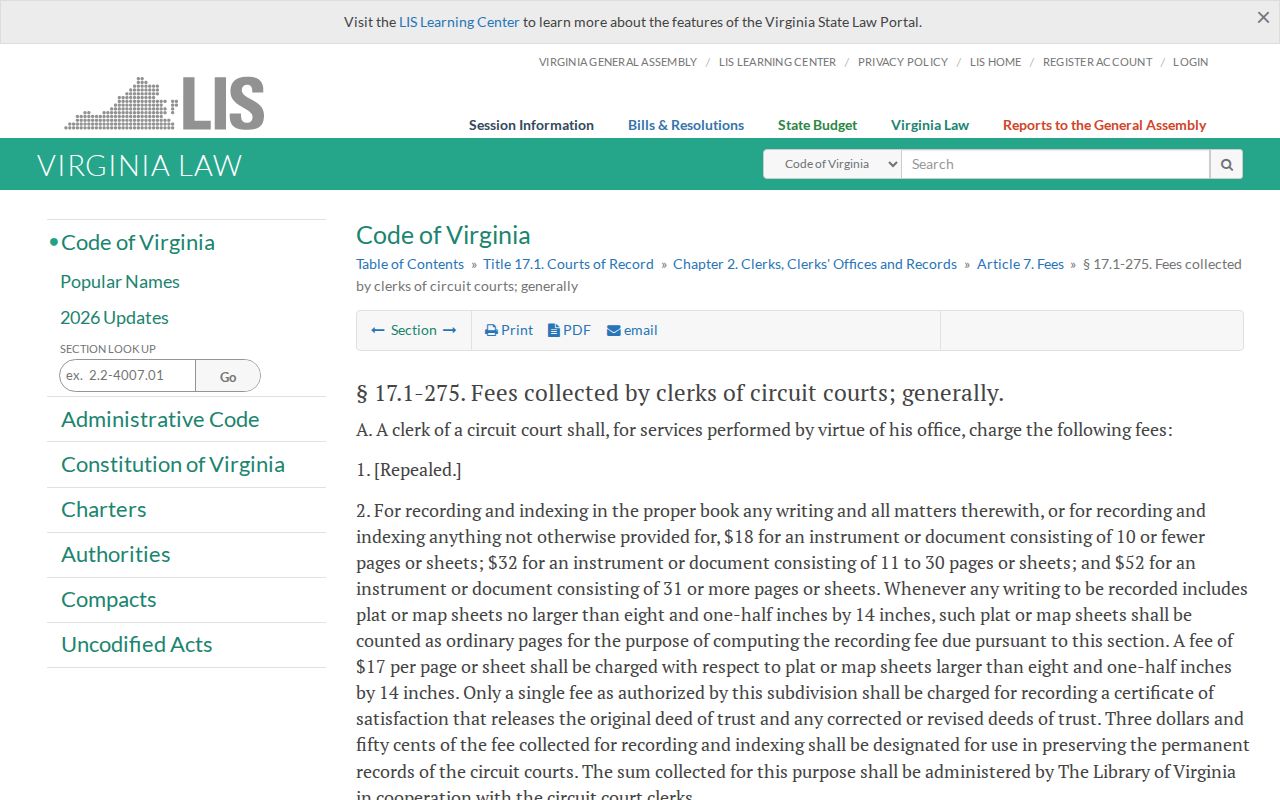
Treat the recording price as covering only that. It does not estimate OCRA access or a copy request unless the Clerk confirms otherwise.
Goodson and Bristol in Early Deeds
Bristol's official charter tells the story of a city that changed its name. The area was established in 1850 as Goodson. It was incorporated as a town in 1856. It became a city named Bristol in 1890. Early record references may therefore say Goodson where later indexes say Bristol. Search both names when investigating an old property. Then confirm land identity through the legal description and the instrument reference, not the label alone. The Library of Virginia guide starts its listed Bristol City land-record microfilm with 1890 material. That gap is a reason to preserve variant names. It is also a reason to ask whether an older item belongs to the same parcel. A council minute or charter note can explain a name change. Only the recorded instrument supports the transfer itself. The name history appears on Virginia's Bristol charter page. Use both names when hunting for the oldest relevant deed or a historic subdivision clue.
Bristol City Deeds, Liens, and Plats
A deed records a transfer or a stated interest. A deed of trust or mortgage is a security instrument. A release or certificate of satisfaction shows that an earlier instrument was paid or discharged. Easements, rights-of-way, restrictive covenants, plats, judgments, lis pendens, and other liens can shape how land is used. They can also cloud a title. Search the related instruments instead of treating the latest deed as the whole file. For a Bristol parcel, match the recorded instrument to the legal description. Match it as well to any referenced plat. Tax balances run through the Treasurer. A judgment or foreclosure issue may also surface in a civil docket. The Circuit Court Clerk's land-record page identifies the local recording function. A case search can explain an action. But the final deed, release, or judgment instrument remains the recorded title evidence.
Older Bristol City Deed Records
When the online index cannot locate a deed, widen the net. Try alternate party spellings, Goodson-era names, and the exact legal description or plat reference. Then ask the Clerk for an inspection or copy. Use the known names, the approximate recording period, the map number, and the instrument type. Bristol FOIA is not the main route for recorded land documents. The Circuit Court Clerk maintains those records and provides the inspection path. For other city-held records, Virginia FOIA applies. It allows inspection, copies, or both when the request is reasonably specific. Bristol's public policy lists mail, fax, email, in-person, and phone request channels. A request never obligates the City to create a new record. Keep deed, tax, and permit requests separate so each one reaches the proper custodian.
Recorded is not the same as guaranteed clear title. A deed index reveals recorded instruments, not every unrecorded claim or legal defect. Use a title professional for a title opinion, and verify the actual Bristol City instrument with the Clerk.